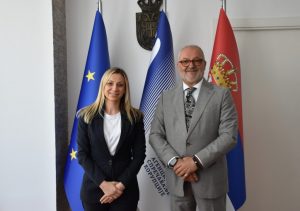

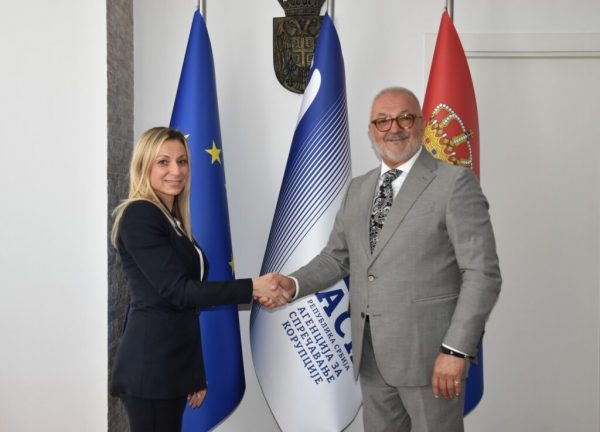
Continuing the long-term successful cooperation of the Agency for Prevention of Corruption with the Republic Commission for Protection of Rights in Public Procurement Procedures, the Director of the Agency Dejan Damnjanović and the President of the Republic Commission Irena Grujić held a meeting aiming to analyse both the achieved results so far and exchange of experience and specific practices of the two institutions, as well as guidelines for future joint activities.
“The goal of cooperation between our institutions is to protect the public interest, reduce the risk of corruption and strengthen the integrity of public authorities,” said Director Damnjanović. “The independence and autonomy of the Agency and the Republic Commission for Protection of Rights in Public Procurement Procedures are preconditions for the quality and unimpeded implementation of our competences and full-capacity-execution of the roles entrusted to the Agency by the Law on Prevention of Corruption, and to the Republic Commission by the Law on Public Procurement”.
The President of the Republic Commission Irena Grujić pointed out that the meeting is of particular importance considering that it takes place at the beginning of the mandate of the President of the Commission, and on that occasion she emphasized: “Timely and efficient exchange of information between our two institutions is crucial for quick preventive action and detection of potential irregularities. By synchronizing of databases, we significantly improve the transparency of the process, which directly contributes to the strengthening of legal security for both contracting authorities and bidders in public procurement procedures.”
The topics discussed during the meeting included areas of common interest that would be defined by signing a new Cooperation Agreement, as well as further improvement of preventive mechanisms that contribute to prevention of corruption in the public procurement system. On this occasion, issues related to protection of rights in public procurement procedures and determination of possible conflict of interest were discussed, as well as the implementation of ethics and integrity training for both Commission’s employees and participants in the public procurement system. Moreover, the Agency’s advisory assistance in developing the Commission’s integrity plan in the new, fourth cycle of this preventive mechanism was considered.
As a conclusion of the meeting, it was pointed out that all joint activities of the two institutions are focused on strengthening of the institutional culture of integrity in public procurement procedures.